Friday, 22 April 2011

Santiago to Puerto Varas

Well we were up early again for our flight from Santiago
 (- this photo is from the plane)
to Puerto Montt and then a bus to Puerto Varas in the south of Chile, and the signs say that it is Patagonia, so we can add that to the list of places we have been. We had a quick tour around the city of Puerto Montt which is located on the Pacific, but is in an inlet and behind a large island, so you can't see out to sea. We stopped at the local fish market and some of the group including Mal went in to see the fish being prepared. we drove a little bit further to Puerto Varas which is located on Lago Llanquihue, the 5th largest fresh water lake in Chile.
The town is very cute with lots of houses that are made of wooden shingles as this area has a German influence. When we were walking around there were cakes that also make you think that you are in Germany, including the signs that say "kuchen" for the cakes. It reminded us of Lake Constance, the lake between Germany and Switzerland, and when we mentioned this to our tour guide she agreed. The hotel is on the side of the hill looking over the lake at the Volcano Osorno, but the weather has been overcast and raining so we haven't seen it, and it looks unlikely that we will. Nevertheless we did a 3 hour tour around our side of the Lake and it reminded us of the Mornington Peninsular - beautifully kept houses and gardens and interesting small farms.

It is currently raining heavily, but it is nice to be able to sit and type this while looking out of the window at the lake that our hotel is located on. The lake is very rough at the moment and the boats are rocking up and down. It is also quite cool, maybe 12C, with a strong wind blowing that makes it feel cooler than that. Everyone is making the most of relaxing after the last few days that have been so busy.


We leave tomorrow for a 4 bus, 3 catamaran trip through the Lake District from Chile to Bariloche in Argentina. We have our fingers crossed for better weather.

Wednesday, 20 April 2011

Santiago Chile

La Paz to Santiago
Well yesterday was certainly a long day. We were up at 6.30 am for a 7.30 am start due to the possible issues with the strikers, but there wasn't any problems so we didn't have to leave until 9.30 am - so just enough time for a quick walk and a cup of coffee.

We arrived at the airport at 10.15 am with no hassles, and then hung around looking at snow covered mountains and duty free shopping until our flight left at 2.35 pm.
We flew from La Paz to Santa Cruz, both cities are in Bolivia. We had to refuel at Santa Cruz as the plane is unable to carry much fuel from La Paz as it is at 4,100 metres, and it has a runway which is twice the length so the planes can lift off due to the high altitude. Then we flew from Santa Cruz, which looked like the Darwin airport from the plane, to Lima (Peru). There we had about 2 hours before our flight to Santiago in Chile. We arrived at the local time of 2.00 am as they are still on daylight saving. We finally switched the lights out at 3.55 am only to have the phone ring saying it was our wake up call. Mals answer was "not for us, we have only just gone to bed".
Around Santiago
We had a late start on our tour today due to the late night. We visited a winery -Concha y Toro - which was to the south of the city. Tenth largest winery in the world.  It is very like Australia as there are gum trees everywhere, but it is much drier here. There was tour of the winery and then a quick tasting. One of the wines they sold at the winery is one that has been purchased a few times by the group so far, Casillero del Diablo, and there are intentions to look for it on our return to Australia.
Then we had lunch at an authentic Chilean restaurant which was really nice, and included people playing the guitar, singing and dancing, but some annoying European Wasps - the first we have seen in South America.


The rest of the day was spent looking at various areas of Santiago including the downtown area, the Cathedral, the main square and the fish and fruit markets. We bought a punnet of raspberries for $A2 and it is twice the size of the ones in Australia. Then our last trip was up the mountain in the middle of Santiago on the Funicular Railway. The views are unfortunately spoiled by the smog which hangs over the whole city during autumn and winter. You could just make out the mountains, but we couldn't see the ocean.


Then it is home to the hotel for a break before we have an early night before a 6.15 am start tomorrow to Puerto Montt.

Monday, 18 April 2011

Around La Paz

Regular readers will recall (are there any, apart from Laura and Brother Ian?) that we said yesterday we would keep an open mind about La Paz until our city tour today.  This was wise.  The night was interesting with lots of explosions that we could only assume were dynamite (coz that's what our tour guide had suggested was happening) but this morning we were informed they were mostly fireworks celebrating something or other, with the miners in town for the strikes chucking a few sticks of dynamite.
The day has been very sunny and warm, and the tour took us to fascinating places, chiefly the Valley of the Moon at the southern end of the city with much eroded landscape in interesting shapes. 


Insane Bolivian cavorting on the moon, flying like a condor, the guide said.


At the moon, with pepper trees and cacti
View from a high point in the middle of the bowl that the city occupies afforded 360 degree views of the valley/bowl, including the soccer stadium and a forest of gum trees to the north which the guide called "the lungs of the city".  There are more gum trees in Peru and Bolivia than  Oz it seems.  There are also lots of wattles and pepper trees, so we felt at home. 


I asked the guide how the visiting soccer teams prepare to play at 3,600metres, and he said the Brazillians fly in 2 hours before the game, then get out asap.  This makes sense.  We all felt fine when we first got to the high altitude in Cusco, but we have been increasingly aware of its effects the longer we have stayed.  So much for acclimitisation.
Drive back to the hotel took us through the upper crust part of town, with mansions costing upwards of $US1 million.  The district reminded Julie and I of the Springfield area of Adelaide, particularly with all the Oz flora, green hedges etc.

After the tour we walked down to the main avenue in blazing sunshine and joined lots of happy families in the long green area running down its middle.  Slow stroll down, found a lazy coffee then slow stroll back, to relax in the room.


Tea at a  neighbouring hotel where Mal presented Elvis with the tour tip ($US620 - he was worth every cent) and we celebrated one of the party's birthday.

Question on everyone's lips: will we get out of here tomorrow it a strike closes down the city? We are due to leave at 9.30am for the 45 min drive to the airport to catch a flight to Lima via Santa Cruz leaving at 2.25pm, then wait to catch another flight to Santiago arriving at 2am!!!  We will be tired chicks.

Sunday, 17 April 2011

Puno to La Paz

Out of the hotel at 7am for the 2 hour drive along the shores of Lake Titicaca to the Bolivian border. Apparently they shut down the strikes in La Paz for the weekend ("even strikers need a break") so we are continuing the adventure.
Checkpoint Charlie between Peru and Bolivia was organised chaos which was a pleasant surprise. Lots of people milling around but we got through the respective immigration points without incident. Onto our Bolivian bus for a drive to more ruins at Tiwanaku. Long tour through a museum which featured a piece of pottery clearly modelled on Dave on our tour. Mal mentioned this to Elvis our Peruvian guide and he cracked up. Dave's comment on this was "I manufacture them in the thousands".  Then a loooong tour through outside ruins which was vaguely interesting but people were more interested in when lunch was, I suspect.
Tiwanaku
When the guide said "now it is time for lunch" Mal found himself hoping "lunch" was not Spanish for"more ruins". (Happily it wasn't). Lunch cost us 40 Bolivianos each for vege soup and omelette and veges and canned fruit juice syrup garnished with a quarter of a tinned peach. This came to $A6each,so prices are even more ridiculously low in Bolivia than Peru.
Arrrived in La Paz at 4pm, and drove down a pretty impressive road view-wise, with towering snow-capped mountains all around - 6,000 metres high (the snow line is at 5,000 metres in the tropics we were informed) and the city sprawling over the whole valley far below.

Got caught in a traffic jam near the hotel thanks to streets being blocked by police because of protests. Lots of honking, and this continues as this is being typed.
We checked in finally then ventured forth onto the less than friendly streets of downtown La Paz. We have agreed to reserve judgement on this place until our city tour tomorrow, but this was tested as we walked down from the hotel. We were desperately looking for a coffee shop and finally found one in the local church! We had steered clear of streets blocked off with riot police with perspex shields everywhere, but they all seemed pretty relaxed and smiling so we figured there wasn't too much protesting happening there.
The church coffee shop was clean and provided sanctuary from the noise and milling confusion on the tiny streets, with honking cars and street hawkers outside. Debated whether to just stay there, but then plucked up courage to walk up to a pedestrian bridge and over the freeway into the upper part of the city. This had a better feel, but featured streetside market booth things all over the footpaths forcing you to cheat death amongst the cars, but at least there were some pedestrian malls as well. This area has a better feel and made us a little happier to be here.

Back to the hotel over the footbridge for a rest before meeting the group again at 7pm for tea. City tour planned for tomorrow.  The night lights are quite impressive - took a snap of them from our hotel:

Saturday, 16 April 2011

Around Puno

Our bus left at 8am for a tour of an Inca burial site north of Puno. There was quite a stir on board because our tour guide had said there was some sort of unrest in Bolivia where we are due to go tomorrow. Strikes, protests on the streets, army in control of the airport etc. We also had to turn back to drop off a member of the party who seemed to be suddenly taken ill with altitude sickness.
The Inca ruins are at 3,900 metres in the middle of rolling hills, with mountains in the distance. It is surreal to think this land is 400 metres higher than the Jungfrau mountain in Switzerland, which had seemed pretty high to us then. The ruins comprised burial towers and the local guide gave an interesting explanation of the religious beliefs (similar to Egyptian beliefs of reverence of the Sun God).

There was a good view of a large blue lake which the guide said was higher than Lake Titicaca. Mal enquired whether this meant this lake must be the highest lake in the world, and the guide replied not so: the present lake was just a "pond". He also said there is a higher lake in Chile, so we're confused.
  The "pond"
Back on the bus to go to Lake Titicaca for a boat trip to the floating reed islands where about 800 people live. It was a bit disconcerting to see cows, pigs, dogs and cats floating in the middle of a lake.

The floating villages are 30 mins by boat and cannot be seen from the shore. It was interesting sitting on masses of dried reed straw out on the lake with straw huts, straw boats, straw towers and of course the obligatory native artifacts and handicrafts (made of straw). Mal for one is a little over all this stuff being thrust at us constantly. But we bought a straw mobile. Nice picnic lunch there, and back on the boat to return to our hotel by 4pm.

We are in a different hotel tonight due to some mix-up in bookings, for which we have been given a free dinner in the hotel tonight. We are doubly pleased because our room is far superior, and twice the size.
Assuming Bolivia is not in flames tomorrow, the intention is for us to still go there, and hope a massive general strike is not called for Monday morning, stranding us. If it was possible, the tour group would rather skip Bolivia and go to Chile where we are not scheduled to spend much time. However, this would be too difficult to organise at short notice, so we shall see what happens. One must retain one's sense of humour in South America, learn to roll with whatever happens and stay cool!

Friday, 15 April 2011

Cusco to Puno

Travel day today, 9.5 hr bus trip from Cusco to Puno on the shores of Lake Titicaca. We stopped first at a hideously gaudy Catholic church which was having all its totally overblown 24 carat gold restored, while just up the road there was a large tent city of victims of the February 2010 floods. This made the blood of a few blokes boil, Mal's included you may be surprised to learn. Next stop was at some impressive Inca ruins at a place called Raqchi, the halfway point of the Inca Trail from Colombia to Argentina. This featured ruins of 156 granaries which covered a very impressive acreage. Must have been a very busy transport hub in its time, with llamas everywhere, the main goods transport.
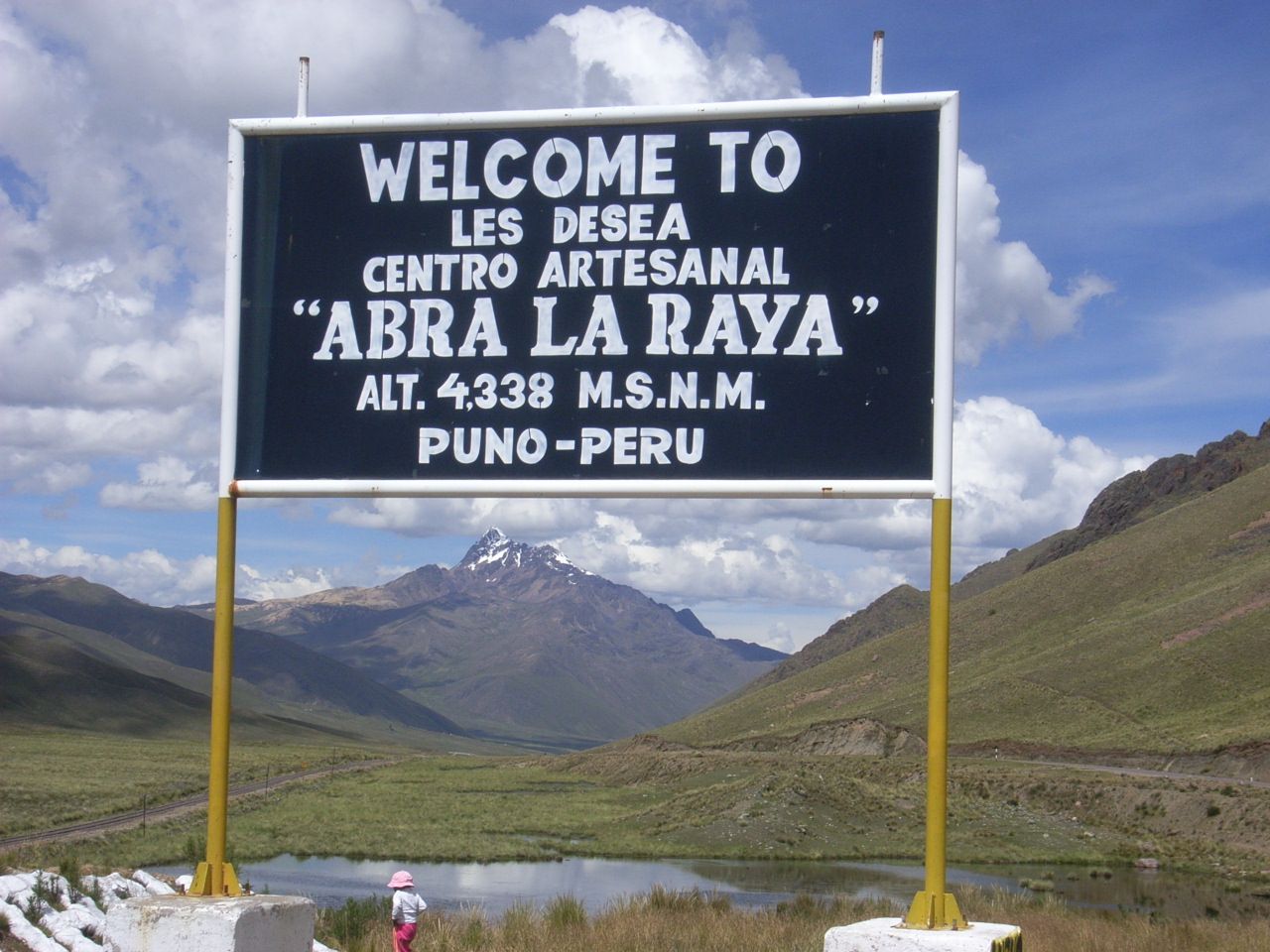
Next stops were for buffet lunch at Sicuani, then at the highest point on the trip, 4,335 metres (14,222 feet) at La Raya, where yet again we faced the gauntlet of hawkers and stall holders and old women dressed in colourful Peruvian getup, holding exceptionally cute llamas, alpacas and lambs, who charge you one Peruvian Sole (30 Aus cents) for a photo and a pat.

Last stop was at a pre-Inca museum at Pucara which wasn't exactly gripping, but the toilets were clean, and free! There was a 5 year old boy trying to flog little ceramic pigs for 5 soles who tried to cajole Greg on our tour into buying some. When Greg refused, the boy said "why won't you buy my pigs?", so Greg just gave him the money, to which he said "no pig?". This stunt of sending out tiny little kids to elicit guilt buying is not one of Peru's best features.
We drove around a town called Juliaca, which featured another of Peru's less than endearing qualities - half-finished buildings. Apparently there is a tax placed on all buildings when completed, so no-one completes them, (as in Cairo, someone commented). A whole city featuring buildings with reinforcing wire sticking out the top looks very ordinary.
Everyone was a little flat due to the altitude during the day. We arrived at Puno at 5.00pm as the sun was setting. 3,845 metres here (12,614 feet for those slow to adjust to metrics), but we are slowly adjusting to the altitude.
The group went out for tea to a nice little place recommended by Elvis our tour leader in Peru, who has an Australian sense of humour and is very well organised and connected. We get a local guide in each country which is very useful - a good feature of Peregrine Tours.
More touring tomorrow around Puno, including a trip on Lake Titicaca to visit the floating islands. Until then.

Thursday, 14 April 2011

Rest day in Cusco: Some reflections on Peru

Easy day today.  Julie has gone off for a morning massage somewhere in Cusco with 2 other ladies, so I'm reflecting on this country in the hotel. 

The food: high quality, well presented and cheap.  Not trying the guinea pig though.


If you're planning on coming back as a guinea pig, make sure it's not in Peru.  They are well and truly stuffed.


The traffic lights are great.  They tell both drivers and pedestrians how much longer they have to wait at a red, and how much time they have left on green.  Our lights should do the same.


We should not copy their method of selecting a President.  The elections were held last Sunday.  First past the post system, whereby a candidate has to get 50%+ of the vote to be elected.  If no-one does, the whole country comes back a month or so later to choose between the 2 candidates with the highest percentage from the first round.  With 11 candidates standing there was always going to have to be a second round.  The candidate coming first got 30% of the vote.  As our tour guide explained: assuming this bloke wins the play-off, he will proudly attend his inauguration with a disapproval rating of 70%, which will rise during his incumbency. Voting is compulsory and there are no postal or absentee votes and no excuses for not voting.  If you are away from home, you travel back to vote.  If you are in hospital, they come in and find you. No vote, you get fined.  So because we were in Machu Picchu for the Sunday vote, our tour guide gets fined because he lives in Lima.

The worst part of the process is the election slogans graffitied all over buildings and posters and billboards blighting everything else.  Even on native huts in the middle of theAmazonian jungle. Insane


The people are very friendly, and the whole place feels very safe.  We are all glad we're spending 2 weeks here.  The kids are gorgeous. Laura, note the monkey!


And of course the animals are very cute.


Llama checking out Machu Picchu

Until next time.

About Me

My photo
Mal and Julie are off to Jakarta, Sth Korea and China in 2026